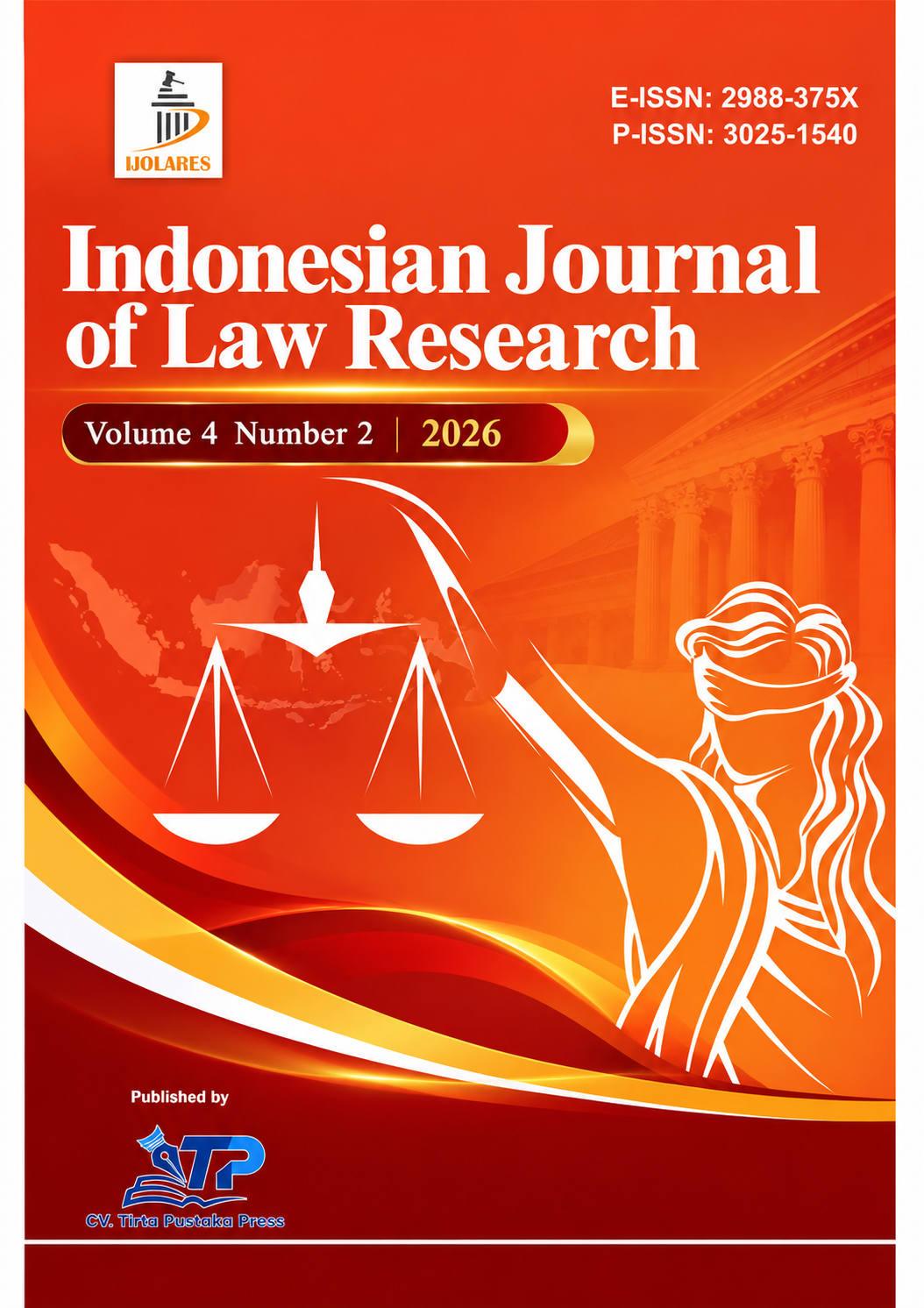
Tourism Law Compliance: Evidence from Bali's Hotel Industry
DOI:
https://doi.org/10.60153/ijolares.v4i2.377Keywords:
Tourism Law Compliance, Socio-Legal Research, Sustainable Tourism, Regulatory ComplianceAbstract
Tourism law compliance is essential for ensuring legal certainty, sustainable governance, and accountability within the hospitality industry. However, empirical evidence on multidimensional tourism law compliance among hotel operators, particularly across licensing, environmental, consumer, labour, tax, and sustainability obligations, remains limited in Indonesia. This study aims to measure tourism law compliance among hotels in Bali across six regulatory dimensions and examine the institutional factors associated with variations in compliance. A quantitative socio-legal design was employed using a structured questionnaire administered to three managerial respondents from each of 100 hotels across Denpasar, Badung, Gianyar, and Buleleng, with the hotel serving as the unit of analysis. Data were analyzed using descriptive statistics, Pearson correlation, and multiple linear regression. Significant predictors, β, p-values, and R² were reported. The findings reveal that the overall tourism law compliance score was high (M = 4.08; SD = 0.54). Licensing compliance (M = 4.35) and tax compliance (M = 4.25) recorded the highest levels of compliance, whereas sustainable tourism practices (M = 3.82) and environmental compliance (M = 3.85) showed comparatively lower performance. These findings indicate that hotels demonstrate stronger compliance with administrative legal obligations than with environmental and sustainability-oriented requirements. The study concludes that effective tourism law compliance is influenced not only by legal enforcement but also by organizational capacity, managerial commitment, and institutional governance. The findings indicate that compliance varies across regulatory dimensions, with stronger performance in administrative obligations than in environmental and sustainability-related practices.
Downloads
References
Abdou, A. H., Hassan, T. H., & El Dief, M. M. (2020). A description of green hotel practices and their role in achieving sustainable development. Sustainability, 12(22), 9624. https://doi.org/10.3390/su12229624
Aksoy, L., Choi, S., Dogru, T., et al. (2022). Global trends in hospitality. Journal of Business Research, 142, 957–973. https://doi.org/10.1016/j.jbusres.2021.12.068
Chung, K. C. (2020). Green marketing orientation: Achieving sustainable development in green hotel management. Journal of Hospitality Marketing & Management, 29(6). https://doi.org/10.1080/19368623.2020.1693471
Dangi, T., & Petrick, J. F. (2021). Augmenting the role of tourism governance in addressing destination justice, ethics, and equity for sustainable community-based tourism. Tourism and Hospitality, 2(1), 15–42. https://doi.org/10.3390/tourhosp2010002
Deng, F., & Zhou, C. (2022). Sustainable Development of Corporate Governance in the Hospitality and Tourism Industry: The Evolution and the Future. Sustainability, 14(7), 4286. https://doi.org/10.3390/su14074286
Disemadi, H. S., Mohd Bajury, M. S., Nurlaily, Anggraini, R., & Sihombing, D. A. (2025). IPR-Based Sustainable Tourism: Comparative Analysis of Indonesia, Malaysia, and Thailand. Legality: Jurnal Ilmiah Hukum, 34(1). https://doi.org/10.22219/ljih.v34i1.43454
Dwyer, L. (2021). Tourism development and sustainable well-being. Tourism Review. https://doi.org/10.1108/TR-06-2019-0255
Iswara, A. M. Y., Suyasa, I. G. A. N. D., Putra, R. A. B. N., & Susanti, P. H. (2026). Tourist Arrivals Increase, Hotel Occupancy Declines: Governance Strategies for Sustainable Tourism Accommodation in Bali. Jurnal Kajian Bali (Journal of Bali Studies), 16(2), 494–521. https://doi.org/10.24843/JKB.2026.v16.i02.p03
Jayanti, L., & Wulandari, W. (2025). Understanding Pro-Environmental Behavior in the Hospitality Industry. Journal of Tourism Sustainability. https://doi.org/10.35313/jtospolban.v5i5.193
Jones, P., & Comfort, D. (2020). The COVID-19 crisis and sustainability in the hospitality industry. International Journal of Contemporary Hospitality Management, 32(10), 3037–3050. https://doi.org/10.1108/IJCHM-04-2020-0357
Manoharan, A., Gross, M. J., & Sardeshmukh, S. R. (2021). Antecedents and outcomes of a culturally diverse workforce in hotels. Journal of Hospitality & Tourism Research, 45(8), 1383–1416. https://doi.org/10.1177/1096348020986906
Melián-Alzola, L., Fernández-Monroy, M., & Hidalgo-Peñate, M. (2020). Hotels in contexts of uncertainty: Measuring organisational resilience. Tourism Management Perspectives, 36. https://doi.org/10.1016/j.tmp.2020.100747
Mensah, I. (2020). Corporate environmental management and sustainable hospitality. International Hospitality Review. https://doi.org/10.1108/IHR-09-2020-0052
Mochtar, D. A., Supriyadi, S., Bawono, S., et al. (2025). Law Reform, Justice, and Sustainable Tourism: Evaluating Legal Impacts on Hospitality Growth and Environmental Sustainability. Journal of Law and Legal Reform, 6(3). https://doi.org/10.15294/jllr.v6i3.23376
Nazarian, A., Velayati, R., Foroudi, P., et al. (2021). Organizational justice in the hotel industry. International Journal of Contemporary Hospitality Management, 33(12), 4418–4438. https://doi.org/10.1108/IJCHM-04-2021-0449
Nunes, L. J. R. (2023). The rising threat of atmospheric CO₂: Causes, impacts, and mitigation strategies. Environments, 10(4), 66.
Ozdemir, O., Han, W., & Dalbor, M. (2022). Economic policy uncertainty and hotel occupancy. Journal of Hospitality and Tourism Insights, 5(2), 253–273. https://doi.org/10.1108/JHTI-08-2020-0149
Permana, I. M. A. A., et al. (2025). Legal Construction and Obligations of Tourism Business Operators Towards the Principles of Sustainable Tourism in the Perspective of Tourism Law. Locus: Jurnal Konsep Ilmu Hukum, 5(3). https://doi.org/10.56128/jkih.v5i3.643
Putranto, D., Astuti, M. T., & Halawa, F. A. (2025). From Compliance to Competitive Edge: Leveraging Technology for Sustainable Hotel Management and Regulatory Advantage in Bali. Journal of Posthumanism, 5(7). https://doi.org/10.63332/joph.v5i7.2837
Putri, B. P., Prawira, M. F. A., & Tour, R. (2025). A Policy Review of the Tourism Ecosystem Paradigm in Indonesia's Law No. 18/2025. Journal of Tourism Sustainability, 6(1). https://doi.org/10.35313/jtospolban.v6i1.202
Robinot, E., & Giannelloni, J. L. (2020). Do hotels' green attributes contribute to customer satisfaction? Journal of Services Marketing. https://doi.org/10.1108/08876041011040627
Sakshi, Shashi, Cerchione, R., & Bansal, H. (2020). Measuring the impact of sustainability policy and practices in tourism and hospitality industry. Business Strategy and the Environment, 29(3), 1109–1126.
Sánchez-Fernández, M. D., et al. (2022). Sustainable hotel management and environmental performance. Sustainability, 14. https://doi.org/10.3390/su14074065
Saputra, K. A. K., & Laksmi, P. A. S. (2024). The Influence of Green Governance, Implementation of Energy Accounting, and Green Human Resource Management on Sustainability Performance: An Empirical Study in the Hospitality Industry in Bali. JIA (Jurnal Ilmiah Akuntansi), 9(1). https://doi.org/10.23887/jia.v9i1.66630
Subrata, K. D. A. P., Triyuni, N. N., & Septevany, E. (2025). Sustainable Tourism through the Tri Hita Karana Concept. ASEAN Journal on Hospitality and Tourism, 23(1), 66–78. https://doi.org/10.5614/ajht.2025.23.1.05
Sujana, N., Widiyatmoko, F. I., & Sujana, M. S. S. (2025). Political Transformation of Indonesian Tourism Law: A Critical Study of Sustainable Tourism Policy. Sociological Jurisprudence Journal, 8(1). https://doi.org/10.22225/scj.8.1.2025.67-72
Sulistiyo, T. D., Oktaviani, D., & Anggiani, S. (2025). Green Certification and Consumer Behaviour: A Systematic Review of Hotel Sustainability Practices. Jurnal Ilmiah Pariwisata. https://doi.org/10.30647/jip.v30i2.1901
Widiatedja, I. G. N. P. (2022). The regulatory failure of spatial planning and its environmental impact: A case study of hotel projects in Bali, Indonesia. Journal of Property, Planning and Environmental Law, 14(1), 25–44. https://doi.org/10.1108/JPPEL-10-2021-0048
Downloads
Published
Issue
Section
License
Copyright (c) 2026 I Wayan Eka Santika, I Made Sujanayasa, Ni Nyoman Tri Thika Dewanthari, Gede Adistina Wira Saputra, A. Basir Mesbah

This work is licensed under a Creative Commons Attribution-ShareAlike 4.0 International License.