| E-ISSN | P-ISSN |
 |
 |






PUBLISHING PROCESS
The Indonesian Journal of Law Research (IJOLARES) is committed to ensuring a transparent, rigorous, efficient, and ethical publication process. Every manuscript submitted to the journal undergoes a structured editorial workflow designed to maintain the highest standards of scholarly publishing.
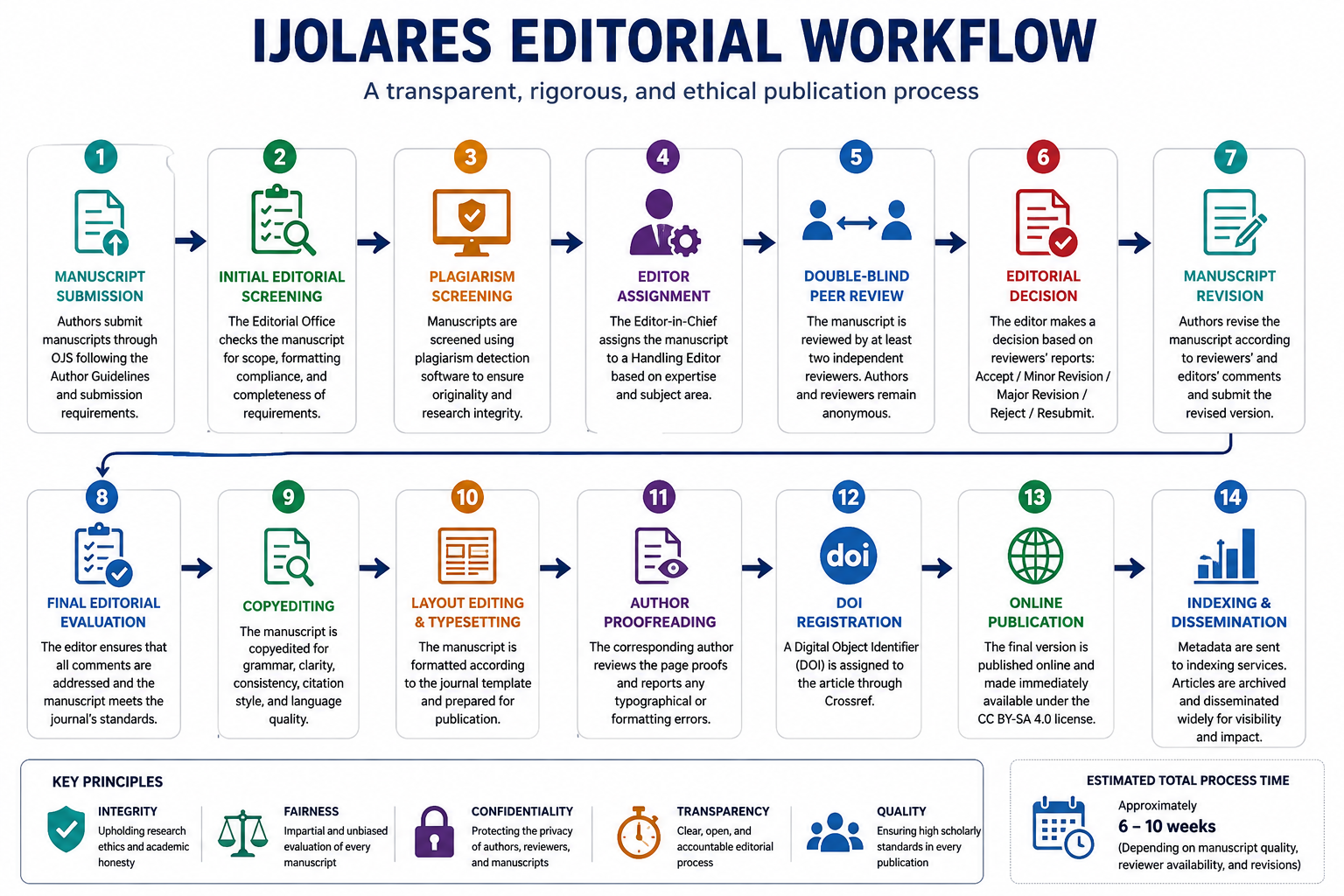
The publication process consists of the following stages:
Authors submit their manuscripts through the Online Journal System (OJS). Before submission, authors must ensure that their manuscripts comply with the journal's Author Guidelines, formatting requirements, ethical standards, and submission checklist.
During submission, authors are required to provide:
After submission, the Editorial Office performs an initial screening to evaluate whether the manuscript:
Manuscripts that do not meet these requirements may be returned to the authors for technical revision before proceeding to peer review.
All submitted manuscripts are screened using plagiarism detection software before entering the peer-review process.
The editorial team evaluates:
Manuscripts containing substantial plagiarism or other forms of academic misconduct will be rejected.
After passing the initial screening, the Editor-in-Chief assigns the manuscript to an appropriate Handling Editor based on the manuscript's subject area and expertise.
The assigned editor oversees the peer-review process and communicates with reviewers and authors throughout the editorial process.
IJOLARES employs a Double-Blind Peer Review system in which the identities of both authors and reviewers remain confidential throughout the review process.
Each manuscript is normally evaluated by at least two independent reviewers with expertise in the relevant field of law.
Reviewers assess the manuscript based on:
Based on the reviewers' recommendations, the Handling Editor and Editor-in-Chief make one of the following editorial decisions:
The editorial decision is communicated to the corresponding author together with the reviewers' comments.
Authors are requested to revise their manuscripts in accordance with the reviewers' and editors' comments.
Revised manuscripts should be accompanied by a detailed Response to Reviewers explaining how each comment has been addressed.
Where necessary, revised manuscripts may be returned to the reviewers for further evaluation.
After all revisions have been satisfactorily completed, the Handling Editor conducts a final evaluation to ensure that:
The Editor-in-Chief makes the final publication decision.
Accepted manuscripts undergo professional copyediting to improve:
Copyediting does not alter the scientific or legal content of the manuscript.
The manuscript is then prepared for publication through layout editing and typesetting.
During this stage, the editorial office:
The corresponding author receives the page proofs for final review.
Authors should carefully examine the proofs and report only typographical, formatting, or production errors.
Substantial changes to the manuscript are generally not permitted at this stage.
Each accepted article is assigned a unique Digital Object Identifier (DOI) through Crossref before publication.
The DOI provides a permanent and citable link to the published article.
The final version of the article is published on the IJOLARES website under the journal's Open Access Policy.
Published articles become immediately available worldwide under the Creative Commons Attribution-ShareAlike 4.0 International (CC BY-SA 4.0) license.
Following publication, article metadata are distributed to relevant indexing and abstracting services where applicable.
Published articles may also be archived in digital preservation systems and institutional repositories to ensure long-term accessibility and preservation.
After publication, the journal remains committed to maintaining the integrity of the scholarly record.
Where necessary, the journal may publish:
in accordance with the journal's Publication Ethics and COPE recommendations.
Estimated Publishing Timeline
|
Stage |
Estimated Time |
|
Initial Editorial Screening |
3–7 days |
|
Plagiarism Screening |
1–3 days |
|
Editor Assignment |
2–5 days |
|
Double-Blind Peer Review |
2–4 weeks |
|
Author Revision |
1–3 weeks (depending on revision type) |
|
Final Editorial Decision |
3–7 days |
|
Copyediting |
3–5 days |
|
Layout Editing & Typesetting |
3–5 days |
|
Author Proofreading |
2–5 days |
|
DOI Registration & Online Publication |
1–3 days |
Estimated Total Publishing Time: Approximately 6–10 weeks, depending on the quality of the submitted manuscript, the responsiveness of reviewers and authors, and the completion of all editorial requirements.
Editorial Workflow
Submission → Initial Editorial Screening → Plagiarism Screening → Editor Assignment → Double-Blind Peer Review → Editorial Decision → Author Revision → Final Editorial Evaluation → Copyediting → Layout Editing → Author Proofreading → DOI Registration → Online Publication → Indexing & Archiving
| JOURNAL TEMPLATE |

| RECOMENDED TOOL |


Published by:
CV Tirta Pustaka Press
Address : Jl. Pandu No. 48, Sumerta Kelod, Denpasar City, Bali 80239
Email : tirtapustakapress@gmail.com
Phone/Telp: +62 852-3783-2582

This work is licensed under a Creative Commons Attribution-ShareAlike 4.0 International License.
